Ripple Ushers In New Year With Sell-Offs: 1,000,000,000 XRP Makes Its Way Out Of Escrow

bitcoinist2026-01-03 tarihinde yayınlandı2026-01-03 tarihinde güncellendi

Özet

Ripple unlocked 1 billion XRP from escrow on January 1, 2026, in three transactions totaling $1.84 billion, amid concerns of increased sell pressure following XRP's negative December close. However, on-chain data shows Ripple quickly relocked 700 million XRP into new escrow contracts within hours, continuing its practice of mitigating supply shocks. The market impact is expected to hinge on how much of the remaining 300 million XRP is sold on exchanges rather than the unlock itself.

The new year opened with a familiar but closely watched event in the XRP ecosystem as Ripple released 1 billion XRP from escrow on January 1, 2026. The unlock arrived at a sensitive moment for price action, coming just after XRP closed December 2025 in the red.

Large escrow releases often lead to concerns about sell pressure, but early on-chain activity suggests the usual Ripple pattern is already unfolding, with a significant portion of the unlocked supply being prepared for relocking.

How The 1 Billion XRP Escrow Release Unfolded

Blockchain data shows the release occurred in three major transactions, all settled within a narrow time window on January 1. Immediately the year started, 300 million XRP, valued at about $552 million, was unlocked and sent to the address rMhkqz, identified as the Ripple (28) wallet. Shortly after, another 200 million XRP, worth about $368 million, followed into the same wallet, bringing Ripple (28)’s intake to half a billion XRP within seconds.

The final and largest portion arrived into a third wallet during which 500 million XRP, valued at approximately $920 million, was released to the r9NpyV address, designated as the Ripple (9) wallet. Together, these transactions completed the scheduled 1 billion XRP escrow release, immediately increasing the circulating supply on paper.

The timing of the escrow release adds complexity to XRP’s near-term outlook. XRP ended December 2025 with a red monthly close of negative 14.8%. Notably, this was the first time XRP closed December in the red since 2022. An influx of unlocked tokens during such a period can increase bearish sentiment, particularly among short-term traders sensitive to supply changes.

Relocking Activity As Ripple Repeats Its Playbook

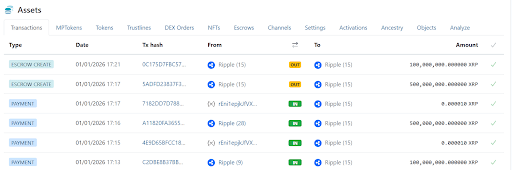
History shows Ripple always relocks between 70% and 80% of each monthly escrow release, a practice that has helped soften long-term supply shocks. Interestingly, activity after the unlocks indicates this approach was repeated within 24 hours of the unlocks. Transaction records from XRPScan reveal that funds exiting the Ripple (9) wallet were quickly routed toward new escrow arrangements, and a substantial share of the newly released supply was removed from immediate circulation.
Source: Chart from XRPScan

Millions of tokens were sent out from both Ripple (9) and Ripple (28) simultaneously. At 17:17 UTC, an escrow creation transaction locked 500 million XRP into the Ripple (15) address, followed by another escrow creation at 17:21 UTC that secured an additional 100 million XRP in the same wallet.

Related Reading: Ripple’s XRP Ledger Just Did Something Bitcoin Has Never Done

Parallel activity was also observed from Ripple (14), where a separate escrow creation locked 100 million XRP at 17:19 UTC. Combined, these transactions accounted for 700 million XRP already placed back into escrow.

The appearance of escrow creation transactions changes the narrative of a supply dump. Instead of a full-scale sell-off, the data points to controlled relocking consistent with Ripple’s strategy of escrow management. XRP’s price response will likely depend less on the headline escrow release itself and more on how much of the remaining unlocked supply reaches crypto exchanges.

XRP trading at $1.88 on the 1D chart | Source: XRPUSDT on Tradingview.com

İlgili Sorular

QHow much XRP was released from escrow by Ripple on January 1, 2026, and what was its total value?

ARipple released 1 billion XRP from escrow on January 1, 2026. The total value of the unlocked amount was approximately $1.84 billion.

QWhat was the immediate destination of the 1 billion XRP after it was unlocked from escrow?

AThe 1 billion XRP was sent to two Ripple wallets: 500 million XRP went to the Ripple (28) wallet (rMhkqz) and 500 million XRP went to the Ripple (9) wallet (r9NpyV).

QWhat is Ripple's historical practice regarding the majority of its monthly escrow releases, and what evidence suggests this pattern was repeated?

ARipple historically relocks between 70% and 80% of each monthly escrow release. Evidence from this event shows that within 24 hours, 700 million XRP (70% of the release) was placed back into new escrow contracts, repeating this pattern.

QWhy did the timing of this escrow release add complexity to XRP's near-term price outlook?

AThe timing was complex because it occurred just after XRP closed the month of December 2025 with a negative 14.8% return, its first red December close since 2022. An influx of new supply during a bearish period can increase negative sentiment.

QWhat will XRP's price response likely depend on, according to the article?

AXRP's price response will likely depend less on the headline escrow release itself and more on how much of the remaining unlocked supply (the portion not relocked) is sold on cryptocurrency exchanges.

İlgili Okumalar

Why is Ethereum Urgently Needing ZK-ification?

The article discusses the urgent need for Ethereum to adopt zero-knowledge (ZK) technology as a core narrative for its future development. While Ethereum previously focused on ICOs, DeFi, and being a global financial settlement layer, it now lacks a compelling new narrative. ZK technology is highlighted as a critical solution, with Ethereum being the blockchain most invested in its development. ZK-EVM has reached the Alpha stage, a milestone celebrated by Vitalik Buterin. The primary motivation for ZK integration is to maintain Ethereum’s decentralization while improving scalability. Currently, increasing the Gas limit boosts TPS but raises node operation costs, potentially centralizing the network. ZK proofs allow nodes to verify transactions efficiently without expensive hardware upgrades, similar to automated exam grading versus manual checking. ZK itself doesn’t directly increase TPS but enables future Gas limit hikes with minimal node cost increases. The recent Fusaka upgrade, including PeerDAS, advances this goal. A ZK-powered Ethereum could achieve over 1000 TPS, strengthening its narrative. The article also addresses the role of third-party ZK teams (e.g., Polygon, Scroll, ZKsync, Taiko), which remain crucial for innovation and testing different ZK-EVM types (Type 1 to 4). ZK-VMs, like Brevis, are noted for higher performance and diversity, as they aren’t constrained by EVM compatibility. While ZK L1 may attract some L2 users, it also benefits L2s by reducing costs and improving foundational infrastructure. In summary, Ethereum’s ZK transformation, after years of development, is entering a critical phase, driven by collaborative efforts between Ethereum and external ZK projects.

marsbit48 dk önce

Why is Ethereum Urgently Needing ZK-ification?

marsbit48 dk önce

BSC Pop-up Store Style Memes: How Can They Compete with Solana?

The crypto market's high-beta phase has reignited the meme coin frenzy, with Solana and Binance Smart Chain (BSC) emerging as two dominant but divergent ecosystems. Solana leverages its high-speed, low-cost infrastructure (0.4s transaction time, ~$0.005 fees) and culture-first approach, epitomized by platforms like pump.fun, where memes evolve from community-driven narratives and often face rapid failure—over 98% of projects eventually collapse. Its top meme tokens, like BONK and WIF, thrive on viral momentum and decentralized innovation, but the ecosystem is highly competitive and transient. BSC, in contrast, relies heavily on central figures like CZ and He Yi, and its EVM compatibility attracts event-driven, sentiment-heavy trading—particularly within Chinese-speaking communities. While BSC memes can achieve rapid, concentrated pumps, they often lack longevity without ongoing influencer support. Data from Dexscreener (as of Jan 12, 2026) highlights key differences: Solana recorded 26.92M transactions ($8.65B volume) vs. BSC’s 5.9M ($7.80B), reflecting Solana’s retail-heavy, high-frequency trading versus BSC’s大户-dominated, narrative-centric rallies. Ultimately, Solana’s strength lies in its resilient, tool-rich culture, while BSC excels in short-term, liquidity-injected opportunities. The choice between chains depends on risk appetite: probability and algorithms on Solana, versus community sentiment and timing on BSC.

比推51 dk önce

BSC Pop-up Store Style Memes: How Can They Compete with Solana?

比推51 dk önce

İşlemler

Spot
Futures

Popüler Makaleler

Tartışmalar

HTX Topluluğuna hoş geldiniz. Burada, en son platform gelişmeleri hakkında bilgi sahibi olabilir ve profesyonel piyasa görüşlerine erişebilirsiniz. Kullanıcıların XRP (XRP) fiyatı hakkındaki görüşleri aşağıda sunulmaktadır.

活动图片